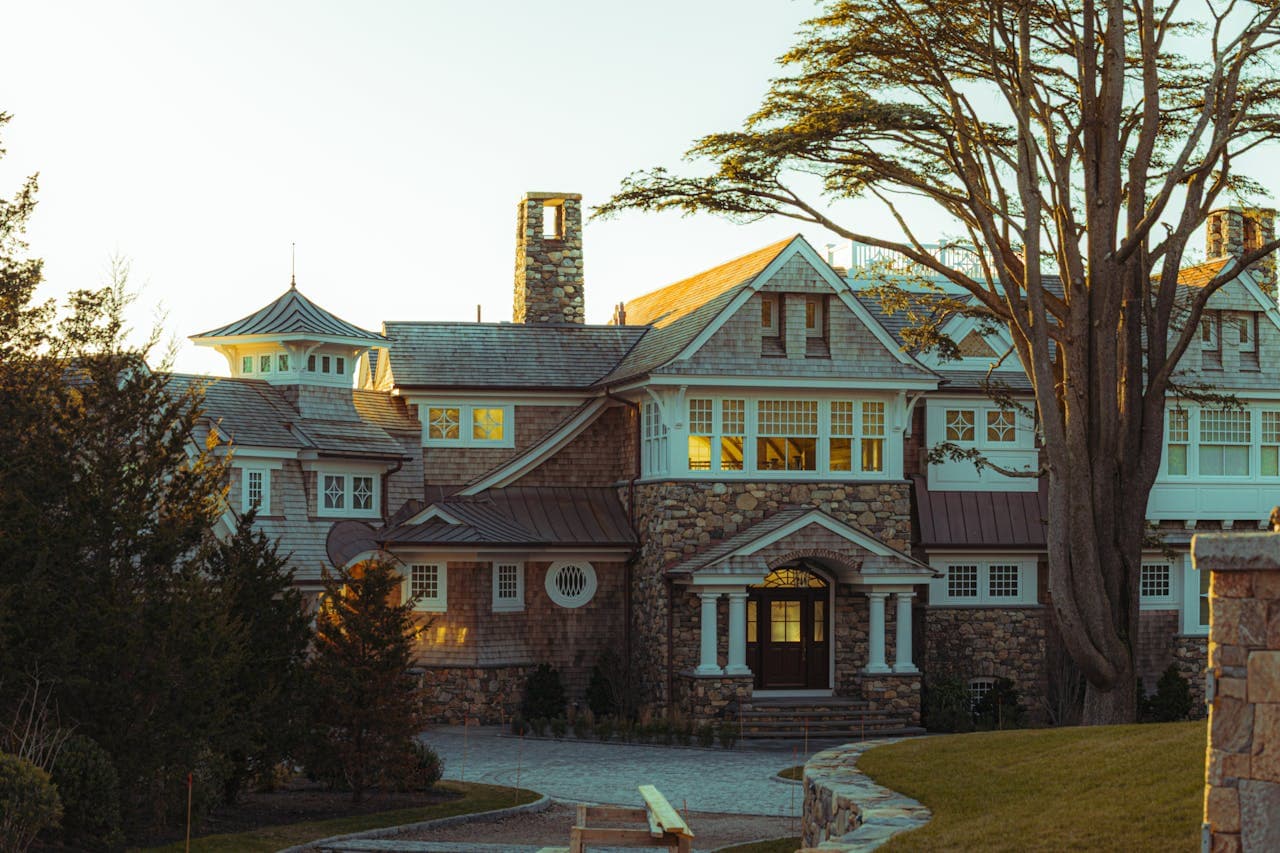
New Construction vs. Existing Homes in Fairfield County: How to Decide
By Matt Caiola
Fairfield County is in the middle of a sustained teardown and rebuild cycle. Aging housing stock from the 1950s through the 1980s is being purchased, demolished, and replaced with new construction at a pace that has reshaped entire streets in Greenwich, Westport, Darien, and Stamford. If you are buying in this market, the question of whether to purchase an existing home or a new-construction property is one you will confront early and often.
The answer is not as straightforward as new-is-better. Each path has financial implications, timeline realities, and lifestyle trade-offs that vary by town, by budget, and by what the buyer values most.
What New Construction Means in Fairfield County
New construction in this market falls into three categories, and the differences are significant.
Spec builds are homes built by a developer without a specific buyer under contract. The developer purchases a lot (often with an existing home that gets demolished), builds to a design they believe the market will absorb, and lists the finished product. Spec builds in Fairfield County range from $1.5 million in Norwalk and Fairfield to $5 million and above in Greenwich and Westport. The advantage is immediacy: the home is finished or nearly finished, and you can close in 30 to 60 days.
Custom builds are homes designed and built to a buyer's specifications on a lot the buyer owns or is purchasing. The buyer selects the architect, the builder, the materials, and the floor plan. This is the most flexible option and the most time-consuming. In most Fairfield County towns, a custom build takes 12 to 18 months from permit approval to certificate of occupancy, and the design and permitting phase can add another 3 to 6 months before construction begins.
Teardown-rebuilds are a hybrid. A buyer purchases a property specifically to demolish the existing structure and build new. The acquisition price reflects the land value, and the total project cost (land plus construction) typically runs 15% to 25% higher than purchasing a completed spec build at comparable quality. The advantage is site selection: you choose the lot, the orientation, and the neighborhood, then build exactly what you want on it.
The Cost Comparison
A common assumption is that new construction costs more than buying an existing home. In Fairfield County, that assumption is often wrong when you account for the full picture.
An existing colonial in Westport listed at $1.8 million may need $200,000 to $400,000 in renovations (a new kitchen, updated bathrooms, a new roof, HVAC replacement, and possibly a septic system upgrade) to match the finish level and energy efficiency of a comparable new-construction home. When you add renovation costs, carrying costs during the renovation (3 to 9 months of payments on a house you cannot fully occupy), and the disruption of managing a construction project in temporary housing, the true cost gap narrows substantially.
New construction in Fairfield County typically costs $350 to $550 per square foot for mid-range finishes and $550 to $800 per square foot for high-end custom work, excluding land. A 3,500-square-foot custom home with quality finishes runs $1.9 million to $2.8 million in construction costs alone. Add a $700,000 to $1.2 million lot (with demolition if applicable), and the all-in cost for a custom home in a desirable Westport or Darien neighborhood reaches $2.8 million to $4 million.
Spec builds eliminate the construction risk premium. A developer has already absorbed the cost overruns, the permitting delays, and the material price fluctuations. What you see is what you pay for, and the per-square-foot cost tends to be lower than custom because builders negotiate volume pricing on materials and subcontractors.
Timeline Realities
The timeline is where new construction demands the most patience, and where expectations most frequently collide with reality.
Spec builds: if the home is completed, closing can occur in 30 to 60 days. If the home is under construction, the builder typically projects 3 to 6 months to completion. In practice, the actual completion date runs 4 to 8 weeks past the initial projection more often than not. Budget for the longer estimate.
Custom builds: plan for 18 to 24 months from the decision to build to the day you move in. The design and permitting phase (3 to 6 months), followed by construction (12 to 18 months), followed by a punch list and certificate of occupancy (2 to 4 weeks). Some buyers complete the process faster, but budgeting for the longer timeline protects against frustration.
Existing homes: the standard Fairfield County purchase timeline is 45 to 60 days from accepted offer to closing. If renovations are planned, add the renovation timeline on top. A kitchen and bathroom renovation typically takes 3 to 5 months once contractors are engaged.
Town-by-Town Building Dynamics
The new-construction market varies significantly by town, largely driven by zoning regulations, lot availability, and the local permitting process.
Greenwich has the most active teardown market in the county. The Back Country and Mid-Country sections see dozens of teardown-rebuild projects per year, and the town's building department has an established process for handling them. The trade-off is cost: land in desirable Greenwich neighborhoods starts at $1.5 million, and construction costs reflect the premium labor market.
Westport sees consistent teardown activity, particularly in the beach neighborhoods near Compo and along the Saugatuck River. The town's zoning and wetland regulations add complexity (and time) to the permitting process, especially for properties near the water.
Stamford's new-construction market splits between the urban core (where condo and townhome development continues to expand the Harbor Point and South End inventory) and North Stamford (where custom homes on large lots follow a pattern similar to Greenwich's Back Country). Darien and New Canaan have more limited teardown activity because the existing housing stock is generally well-maintained, and lot sizes are smaller, which constrains what can be built within the zoning envelope.
When Existing Makes More Sense
New construction is not always the right answer. There are several scenarios where purchasing an existing home delivers better value.
If the neighborhood you want has limited or no new construction (Southport in Fairfield, Rowayton in Norwalk, downtown Westport), an existing home is the only path in. These areas are desirable precisely because the housing stock has character that new construction cannot replicate.
If your budget is below $1.5 million, existing homes offer substantially more square footage and lot size per dollar than new construction in most towns. The new-construction premium is most pronounced at lower price points, where it can add 30% to 40% to the cost of an equivalent amount of space.
If your timeline is under six months, a completed existing home that needs minimal updating is the practical choice. Even the fastest spec build involves a closing process, and custom builds are simply not viable on that timeline.
And if architectural character matters to you (antique wide-plank floors, hand-cut stone walls, original millwork), those details cannot be manufactured. They come with the home or not at all.
Whether you are drawn to new construction or an existing home, the evaluation process requires different expertise for each path. I work with buyers on both sides of this decision regularly and can walk you through the trade-offs at your price point and in your target towns. Reach out anytime. Matt Caiola, Higgins Group Private Brokerage.