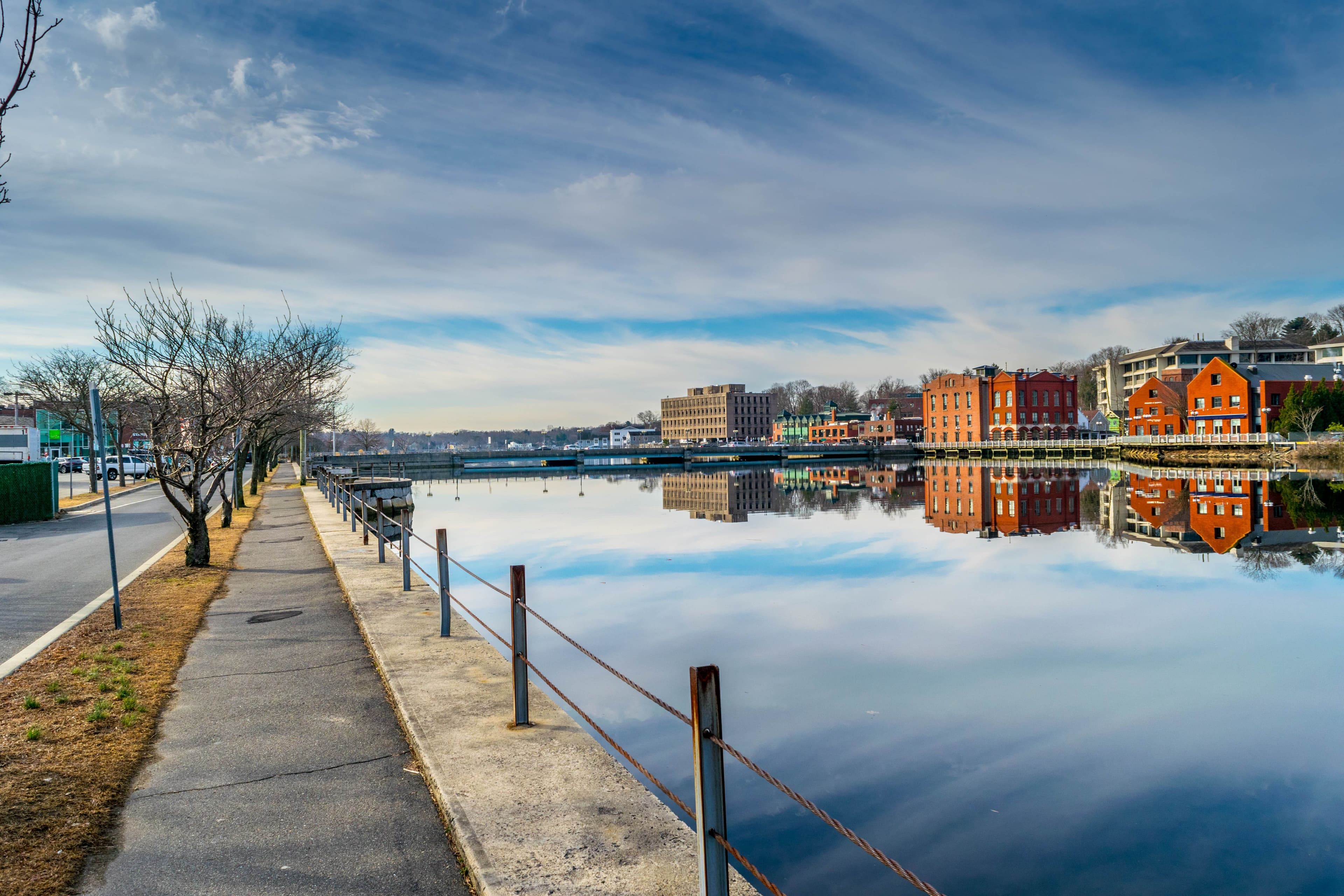
Why Westport Continues to Attract Families and Professionals
By Matt Caiola
Westport appears on every list of Connecticut's most desirable towns, and the data supports the reputation. Median home prices have climbed steadily for five consecutive years. The public schools rank in the top 2% nationally. Inventory turns over faster here than in almost any comparable Fairfield County market. But numbers alone don't explain why buyers consistently choose Westport over equally well-ranked alternatives. The answer is more specific than generic livability, it's about what Westport actually delivers on a Tuesday afternoon.
A Downtown That Functions Year-Round
Many Connecticut towns have a "downtown", a handful of shops and a restaurant or two clustered near the train station. Westport's commercial center along Main Street and the Post Road is a different category entirely. The Westport Library, rebuilt in 2019 as a $40 million civic landmark, anchors the west end. The Westport Country Playhouse draws regional audiences. Restaurants like Tavern on Main, Jesup Hall, and The Whelk at Saugatuck offer dining that rivals what buyers left behind in the city.
The commercial mix matters because it creates a daily rhythm that's walkable and active without being congested. On a weekday morning, the coffee shops along Main Street are full of remote workers and parents between school drop-off and their first meeting. By Saturday, the farmers' market at the Imperial Avenue lot draws families from across the region. This sustained activity is what distinguishes Westport from towns where the downtown empties by 6 PM.
Schools as a Market Driver
Staples High School is the anchor of Westport's school system and one of the primary reasons families pay a premium to live here. The school consistently places among the top public high schools in Connecticut, with strong AP participation, competitive college placement, and strong arts and athletics programs. The elementary schools (Coleytown, Greens Farms, Kings Highway, Long Lots, and Saugatuck) each serve defined geographic zones, and their reputations influence micro-market pricing at the neighborhood level.
I've worked with buyers who narrowed their search to specific elementary school zones within Westport, adding $100K-$300K to their budget to secure an address in the Greens Farms or Long Lots district. That's not irrational, it reflects a genuine value judgment about educational quality and community identity that holds up at resale. Homes in the strongest school zones in Westport consistently appreciate faster than those in adjacent zones, and I factor that into both buying and listing strategy.
Commute Access and the Hybrid-Work Advantage
Westport's Metro-North station sits right on the Saugatuck River, within walking distance of downtown and the Saugatuck neighborhood. Express trains reach Grand Central in approximately 55-60 minutes. For the three-day-a-week commuter (which now describes the majority of Westport's professional residents) that schedule is manageable. Two mornings on the train, three mornings in a home office with a view of the backyard. The lifestyle arithmetic works in a way that it didn't when five-day commuting was the norm.
The town also benefits from its position along I-95 and the Merritt Parkway, giving residents highway access to Stamford's corporate corridor (20 minutes), Bridgeport's emerging biotech and health-sciences campus (15 minutes), and the broader Connecticut economy. Buyers who split time between a New York office and a Stamford-area employer find Westport geographically optimal in a way that more northern towns like New Canaan or Wilton cannot match.
The Housing Market Reflects Sustained Demand
Westport's median single-family home price has crossed $1.5M, and average days on market for properly priced homes hovers around 21. Those numbers reflect a market where demand consistently exceeds supply. The housing stock ranges from antique capes near Compo Beach to mid-century ranches in the Coleytown area to new construction colonials on the north side of the Post Road priced at $2.5M-$4M.
What keeps Westport's market this competitive is the depth of its appeal. It's not a one-dimensional town. Schools, downtown, beaches, culture, commuter access, and architectural variety all contribute to a buyer pool that's both deep and diverse. When I list a home in Westport, the audience includes NYC relocators, Stamford upsizers, intra-Westport movers, and empty-nesters downsizing from larger properties on the north side. That breadth of demand is the best insurance a homeowner can have against market downturns.