Stamford: From Harbor Views to Back Country Estates
By Matt Caiola
Stamford is the most misunderstood city in Fairfield County. People who have not spent time here picture a corporate office park surrounded by parking garages. What they miss is that Stamford contains more residential variety per square mile than any other municipality in the county, waterfront condos, walkable urban neighborhoods, established suburban streets, and genuine back-country acreage, all within a single city boundary.
That range is the city's defining characteristic. A buyer can purchase a $400,000 one-bedroom at Harbor Point and a $2.5 million colonial on five acres in North Stamford, and both transactions happen in the same zip code cluster. No other town in lower Fairfield County offers that spread. Greenwich does not have the urban core. Norwalk does not have the acreage. Stamford has both, and the 47-minute express to Grand Central Terminal ties it all together.
Downtown and the South End Waterfront
Downtown Stamford has more energy than any other downtown in Fairfield County, and it is not particularly close. Bedford Street is the spine, restaurants, bars, and storefronts line both sides for several blocks, and foot traffic runs well past 10 PM on weekends. Atlantic Street connects the train station to the commercial core, and the blocks between those two corridors hold the highest concentration of dining options outside of Manhattan on this stretch of the Northeast Corridor.
The restaurant scene is legitimate. This is not a suburban downtown trying to fill storefronts. There are multiple James Beard-recognized chefs operating in the city, and the range runs from Peruvian to Thai to Italian to elevated American. Columbus Park anchors the civic side of downtown, the park hosts a weekly farmers' market in season, summer concerts, and an annual Fourth of July celebration that draws crowds from across the county.
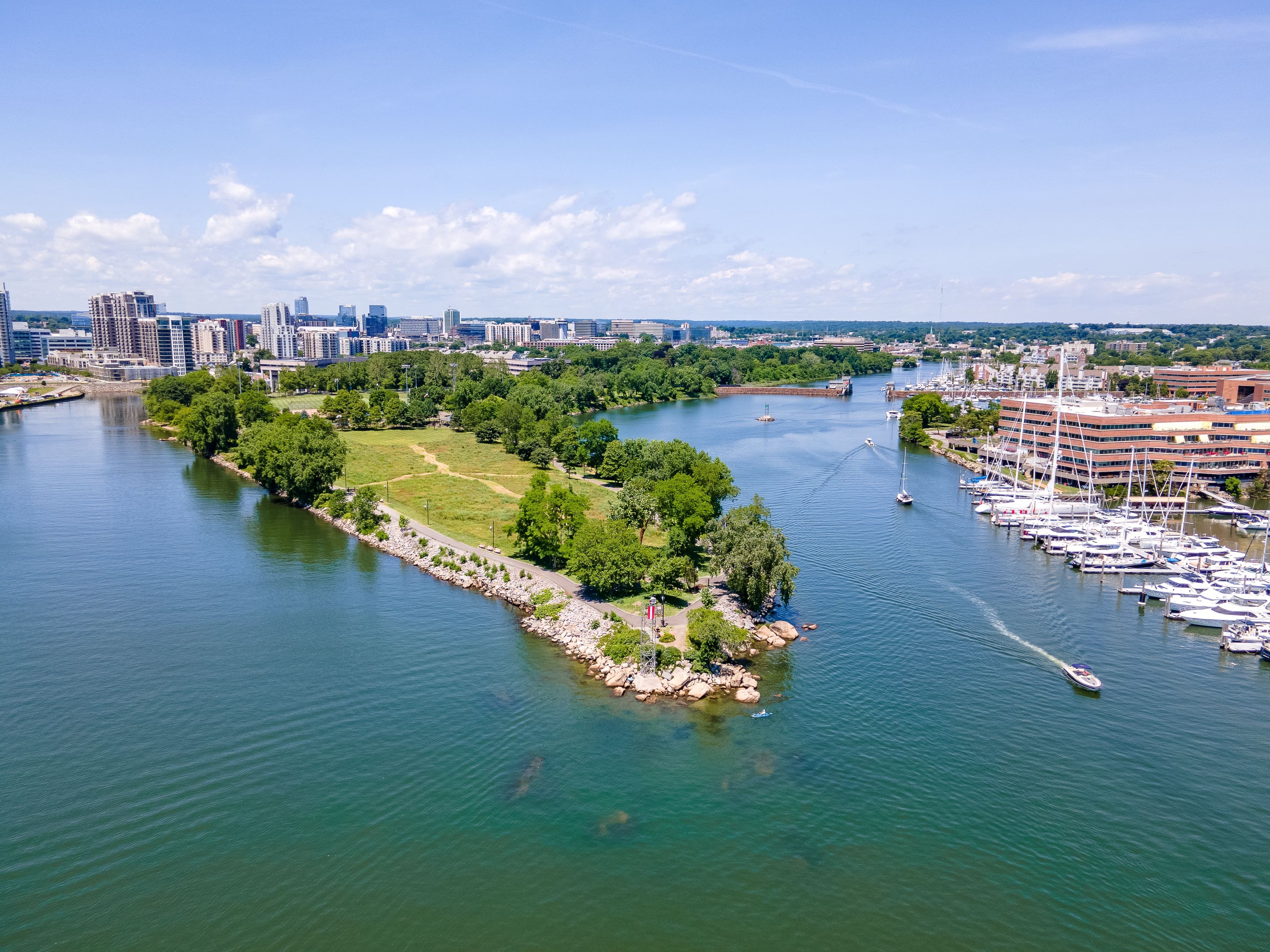
South of I-95, the waterfront has undergone a complete transformation over the past decade. Harbor Point is the centerpiece, a mixed-use development along the harbor that includes residential towers, retail space, a boardwalk, and direct water access. The Harbor Point boardwalk stretches along the waterfront and is one of the few places in Fairfield County where you can walk from your apartment to the water, grab a coffee, and watch boats come in, all without getting in a car.
Housing in the downtown and South End is predominantly condos, rentals, and townhomes. Purchase prices for condos start around $350,000 for a studio and run to $1.2 million for larger waterfront units with premium finishes. The buyer profile here skews younger than the rest of the county, professionals in their late twenties through early forties who want a walkable lifestyle and are not ready for (or interested in) a colonial on an acre.
For investors, the rental market in downtown Stamford is among the tightest in the county. Vacancy rates stay low because the corporate base (Charter Communications, Synchrony Financial, WWE (now TKO Group)) generates consistent demand. A well-located two-bedroom condo near the train station can command $3,200 to $4,000 per month.
Shippan and the Mid-Ridges
Head south past the downtown core and you reach Shippan, a peninsula that juts into Long Island Sound. Shippan is where Stamford's waterfront single-family market lives. Streets like Shippan Avenue and Ocean Drive West offer direct water views, private docks, and homes that range from updated mid-century ranches to newly built waterfront estates priced above $2 million. The peninsula has its own small commercial cluster (a deli, a pizza place, a marina) and a distinct neighborhood identity that operates somewhat independently from the rest of the city.
Moving north and inland from downtown, the mid-ridges (Westover, Turn of River, and Springdale) represent the traditional suburban layer of Stamford. These neighborhoods are defined by tree-lined streets, quarter-acre to half-acre lots, and housing stock that ranges from 1950s capes to 1990s colonials. Prices in this band typically run $700,000 to $1.4 million. The Springdale section has its own Metro-North station, which makes it particularly attractive to commuters who want suburban living without sacrificing direct train access.
These mid-ridge neighborhoods are where many families land when they outgrow a downtown condo but want to stay in Stamford. The schools serving these areas (Westover Magnet Elementary, Turn of River Middle School) are solid, and the commute downtown is ten minutes. For buyers relocating from New York who want house-and-yard living without the price tags of Greenwich or Darien, this part of Stamford consistently delivers.
Springdale in particular has a quiet commercial village along Hope Street with a few restaurants, a dry cleaner, and a hardware store. It operates like a small town grafted onto the edge of a city. Buyers who discover Springdale often remark that it does not match their mental picture of Stamford at all, and that is precisely the point.
North Stamford: Acreage, Privacy, and the Mianus River
North Stamford is where the city stops looking like a city entirely. Once you cross the Merritt Parkway heading north, the scenery shifts to winding roads, stone walls, horse properties, and two-to-five-acre lots shaded by mature hardwoods. This is back country in everything but the municipal mailing address. Homes here sell for $1.2 million to $2.5 million and above, with the highest prices reserved for properties with acreage, updated interiors, and proximity to the Mianus River Park.
Mianus River Park is a 390-acre nature preserve with hiking trails along the river gorge, rocky outcroppings, and some of the most scenic terrain in Fairfield County. It is shared between Stamford and Greenwich, and residents on both sides consider it a major quality-of-life asset. If you are the kind of buyer who wants to hike on a Saturday morning and dine on Bedford Street that same evening, North Stamford positions you to do both without compromise.
The Stamford Museum & Nature Center sits on 118 acres in this part of the city and includes a working farm, an observatory, walking trails, and rotating art exhibitions. It is one of those institutions that families discover after moving in and then cannot imagine living without. The Nature Center, combined with Mianus River Park and the Bartlett Arboretum further north, gives this section of Stamford a conservation corridor that rivals the green space access in far more rural towns.
North Stamford buyers tend to be established professionals (often in their forties or fifties) who have already done the downtown condo and the mid-ridge colonial. They want land, quiet, and a property that provides real separation from the workweek. The trade-off is a longer drive to the train station, typically 15 to 20 minutes. For buyers commuting only two or three days a week, that trade-off is easy to absorb.
Stamford's Dual Identity
The reason Stamford works for so many different buyers is that it operates as two places at once. The southern half is urban, dense, walkable, transit-connected, and culturally active. The northern half is suburban-to-rural, private, green, spacious, and quiet. The Merritt Parkway is the informal dividing line, and crossing it in either direction takes under ten minutes. You get the proximity without the overlap.
That dual identity also means Stamford absorbs market shifts differently than single-character towns. When urban demand surges, the downtown and Harbor Point absorb it. When suburban demand spikes (as it did during 2020 and 2021) the mid-ridges and North Stamford absorb it. The city does not get knocked off balance by a single trend because it serves multiple buyer profiles simultaneously.
Metro-North express service to Grand Central in 47 minutes ties the entire package together. Whether you live on Shippan Avenue or on a wooded lot off High Ridge Road, your Manhattan commute is under an hour. That single fact (combined with the housing variety, the dining, the waterfront, and the green space) is why I continue to recommend Stamford to buyers who might otherwise default to the smaller towns along the shoreline.
If you want to explore what Stamford looks like at your price point and lifestyle, I am happy to map it out with you. The city has more range than a single showing can reveal. Reach out anytime. Matt Caiola, Higgins Group Private Brokerage.