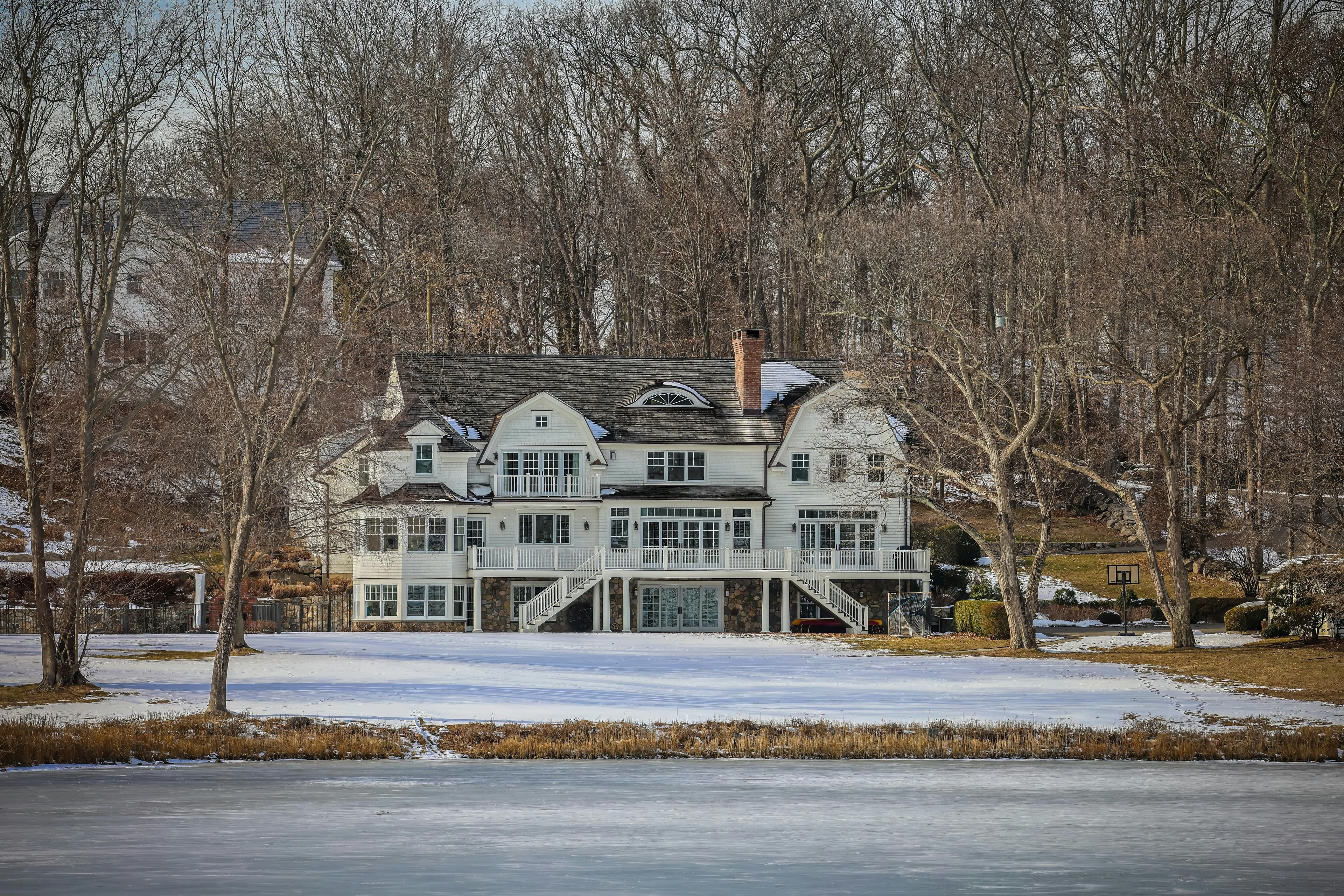
New Canaan: Architecture, Village Life, and Why Buyers Return
By Matt Caiola
New Canaan is one of those towns that people visit once and then spend years finding their way back to. The village center is walkable and specific, not a generic Main Street lined with national chains, but a tight grid of independent shops, restaurants, and cultural institutions that give the town a character entirely its own. Add a globally significant architectural legacy, a top-tier school district, and a 47-minute express train to Grand Central, and you begin to understand why this market holds its value with such consistency.
I work with buyers across Fairfield County, and New Canaan draws a distinctive profile: people who prioritize design, walkability, and a town center they can actually use on a daily basis. This is not a bedroom community. It is a place where residents build their routines around the village, and the town rewards that investment.
The Glass House and New Canaan's Architectural DNA
No discussion of New Canaan is complete without Philip Johnson's Glass House. Built in 1949 on Ponus Ridge Road, the Glass House is one of the most important works of modern residential architecture in the world. It is now a National Trust for Historic Preservation site, open for tours from May through November, and it draws architecture students, design professionals, and curious visitors from across the globe.
But the Glass House is not an isolated artifact. It is the most visible piece of a broader architectural movement that took root here in the mid-twentieth century. The Harvard Five (Johnson, Marcel Breuer, Landis Gores, John Johansen, and Eliot Noyes) all built homes in New Canaan during the late 1940s and 1950s. Their work established the town as a laboratory for residential Modernism, and dozens of their designs still stand throughout the community.
That legacy shapes the market in tangible ways. New Canaan has a preservation culture that values architectural integrity. Mid-Century Modern homes here trade at a premium when they have been thoughtfully maintained or restored. Original Breuer and Noyes houses are rare and collectible. Even newer construction in town often reflects a design-forward sensibility that you do not see as consistently in neighboring communities.
The New Canaan Historical Society and the local chapter of the AIA actively promote the town's architectural heritage through tours, lectures, and preservation advocacy. This is a community that takes its built environment seriously, and that seriousness translates into property values that reflect not just square footage and lot size, but design quality and historical significance.
Elm Street and the Village Center
New Canaan's downtown is organized around Elm Street, which runs through the center of the village and serves as the commercial and social spine of the town. This is not a long corridor (you can walk the entire downtown in fifteen minutes) but the density of quality businesses packed into that stretch is remarkable.
Rosie is the restaurant that anchors many weekend mornings, a breakfast and brunch spot with a loyal following and a line out the door on Saturdays. Elm, the restaurant (yes, named after the street), serves a refined New American menu and has become a destination dining option that draws people from surrounding towns. On Pine Street, which intersects Elm near the train station, a cluster of independent shops carries everything from home goods to specialty foods to high-end children's clothing.
The Playhouse on Elm Street (the New Canaan Playhouse, now a cultural venue) and the New Canaan Library, which recently completed a stunning modern renovation designed by Centerbrook Architects, both contribute to a downtown that is not purely commercial. There is cultural programming here. There are events, exhibitions, and community gatherings that give the village center a gravity beyond retail.
Walkability is the operative word. Residents who live within a mile of the village (and many do) can handle their morning coffee, a doctor's appointment, lunch, a stop at the dry cleaner, and a grocery run without ever starting a car. That is not a theoretical walkability score generated by an algorithm. That is actual, practical, daily life. It is one of the core reasons buyers commit to New Canaan and stay.
The Commute: 47 Minutes to Grand Central
New Canaan sits on a Metro-North branch line that connects to the New Haven Line at Stamford. The express service reaches Grand Central Terminal in approximately 47 minutes, competitive with most of lower Fairfield County and considerably faster than many towns further inland. The branch line means a transfer at Stamford for some trips, but the express schedules are timed to minimize that connection gap.
The train station itself sits right at the edge of the village center, which creates a natural integration between commuting and village life. You step off the train and you are immediately in downtown New Canaan. No shuttle. No parking lot walk. You can pick up groceries at Walter Stewart's Market on your way home, stop at Rosie for takeout, or walk directly to your house if you live in one of the in-town neighborhoods.
With hybrid work now standard across much of the financial services and professional services sectors, the commute question has evolved. A buyer who goes into Manhattan two or three days a week evaluates the train differently than a buyer who commuted five days. The 47-minute express becomes entirely manageable at that frequency, and the quality of life on non-commute days (when you are walking to a village coffee shop instead of sitting on a subway) tilts the equation heavily toward New Canaan.
Waveny Park: 250 Acres in the Center of Town
Waveny Park is not a small-town park. It is 250 acres of open meadows, wooded trails, athletic fields, a paddle tennis facility, and the historic Waveny House, a 1912 Tudor Revival mansion that serves as a backdrop for community events and private functions. The park is the recreational center of New Canaan, and its scale is difficult to appreciate until you have walked it.
On any given Saturday, you will find youth soccer and lacrosse on the fields, runners on the trails, families on the playground, and dog walkers circling the meadow paths. The New Canaan cross-country team trains here. The summer concert series fills the lawn in front of Waveny House. It is the closest thing the town has to a public commons, and it functions as exactly that, a shared space where the community shows up.
For buyers evaluating the town, Waveny is a significant amenity. A 250-acre park within walking or biking distance of most neighborhoods is unusual in any market. In Fairfield County, where open space is finite and increasingly valuable, it is exceptional.
Schools and Community Investment
New Canaan Public Schools rank among the strongest in Connecticut. New Canaan High School consistently appears in state and national rankings, with high college placement rates, strong Advanced Placement participation, and strong extracurricular programs. The district operates three elementary schools, one middle school (Saxe Middle School), and the high school.
The community's investment in education extends well beyond standardized metrics. Parent involvement is exceptionally high. The New Canaan Education Foundation raises substantial private funding to supplement district programs, supporting initiatives in technology, arts, and student wellness that go beyond what the operating budget covers. That layer of private investment creates programming depth that distinguishes the district from peers.
St. Luke's School, a private independent school serving grades 5 through 12, is also located in New Canaan and adds another educational option. Families who want private school access without a long commute have a strong local choice, which is another draw for the town.
Housing: From $1.2 Million to $5 Million and Beyond
New Canaan's housing market starts around $1.2 million for smaller homes on the outer edges of town, typically three-bedroom colonials or ranches on modest lots. These are the entry point for families who want the school district and village access without committing to a $3 million purchase. Demand at this level is consistently strong, and inventory is persistently thin.
The $2 million to $3.5 million range is where most of the market's activity concentrates. At this level, you are looking at four- and five-bedroom homes on one to two acres, often with renovated kitchens, finished lower levels, and the kind of lot privacy that New Canaan's zoning protects. Many of these homes are within a short drive or bike ride of the village center and Waveny Park. The combination of space, location, and school district makes this band the most competitive in town.
Above $3.5 million, the market moves into estate-scale properties, larger lots, more significant architecture, and in some cases, the kind of Mid-Century Modern pedigree that attracts design-motivated buyers from New York and beyond. Properties above $5 million are less frequent but represent the pinnacle of the New Canaan market: multi-acre compounds, architect-designed homes, and sites with historical significance.
New construction in New Canaan tends to be architecturally considered. The town's design culture, its preservation community, and buyer expectations all push builders toward higher-quality materials and more intentional design than you see in some neighboring markets. A spec build in New Canaan is expected to have a point of view, not just a floor plan.
Why Buyers Return to New Canaan
I see a pattern that repeats itself regularly. A family relocates from the city, looks at five or six Fairfield County towns, tours homes in all of them, and then narrows to New Canaan. Sometimes they lose a bidding war on their first attempt and end up buying in a neighboring town. Two or three years later, they are back, looking at New Canaan listings again. The village, the park, the architecture, the school system, the combination creates a pull that persists even after people settle elsewhere.
That is not marketing language. It is an observable market behavior that shows up in transaction data and in the conversations I have with buyers and sellers every week. New Canaan earns loyalty because it delivers on what it promises: a town with genuine character, real walkability, strong schools, and a built environment that reflects serious attention to design and quality.
If New Canaan is on your list (or if it should be) I am happy to discuss the current market, available inventory, and what different neighborhoods within town offer for your specific priorities. Reach out anytime. Matt Caiola, Higgins Group Private Brokerage.