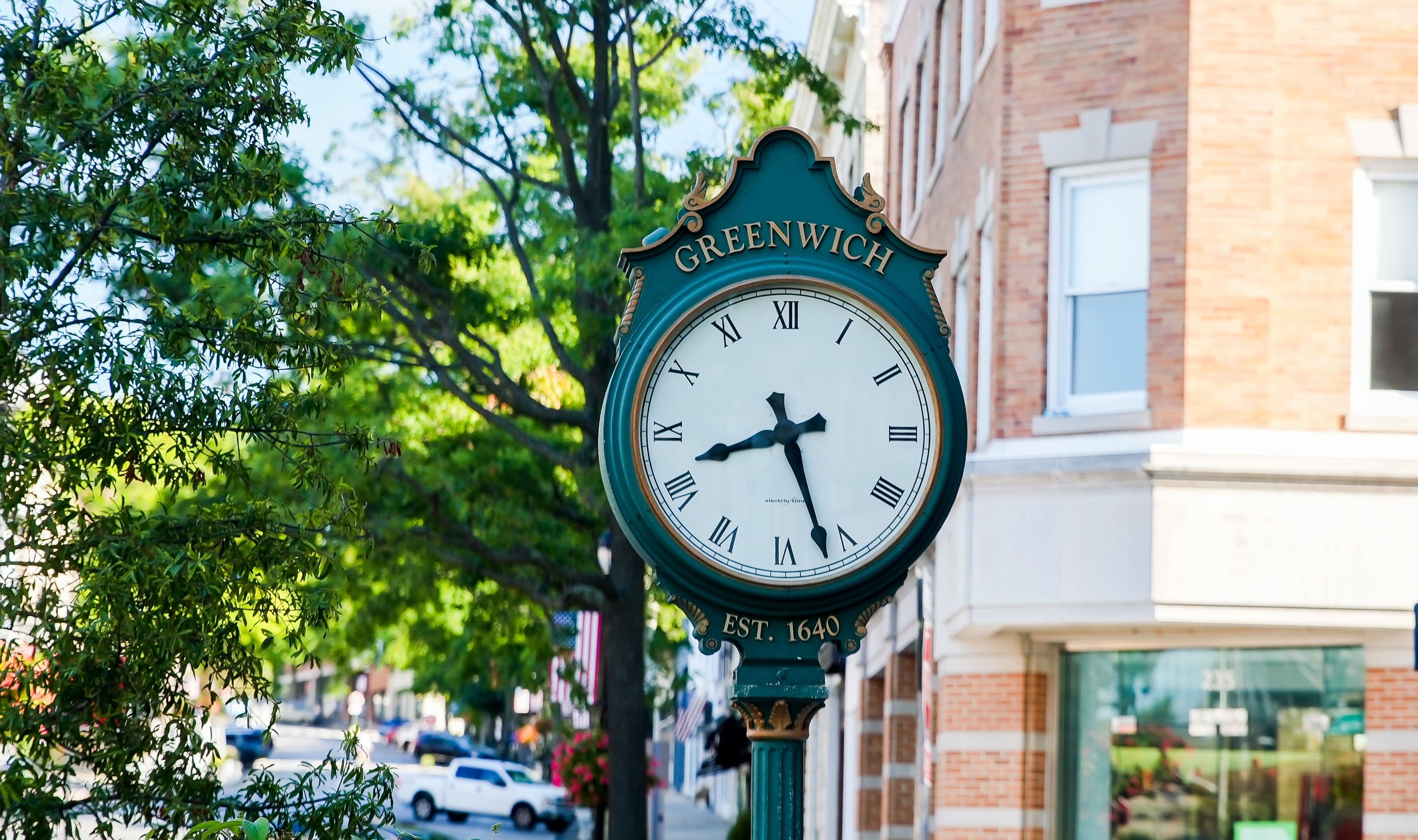
Greenwich, Connecticut: A Town Guide for Buyers, Section by Section
By Matt Caiola
Greenwich is usually discussed as a single address, the wealthy town at the southwestern corner of Connecticut where Fairfield County meets the New York line. Anyone who spends real time here learns quickly that Greenwich is not one market. It is a collection of distinct communities, each with its own geography, price structure, and rhythm, running from the Long Island Sound shoreline north to the four-acre estate zones along the New York border. A waterfront colonial in Riverside, a walk-to-town condominium near Greenwich Avenue, and a gated estate in the backcountry are all Greenwich, and they attract entirely different buyers. Understanding those sections is the first step to buying well here.
The headlines fixate on trophy estates, but the working market is broader than that. I represent buyers and sellers across Fairfield County, and Greenwich is the town where the distance between reputation and reality is widest. The actual market runs from attainable condominiums in Byram to waterfront compounds that set national price records, and most of the interesting decisions happen in between. In 2026, the median single-family sale price in town is about $2.3 million, and Greenwich carries the highest price per square foot in Fairfield County, around $865. Homes have been selling right around their asking price, and the gap between the median asking price of active listings, close to $3.9 million, and what actually sells tells you the standing inventory skews high while the broader market clears lower. That is a market with real depth and real competition, not the slow, rarefied place outsiders imagine.
Greenwich Avenue and Central Greenwich
Central Greenwich is the town's commercial and civic heart, organized around Greenwich Avenue, the sloping retail street that runs from the Post Road down toward the harbor. The Avenue carries a mix of flagship boutiques, restaurants, and longtime local businesses, and the blocks closest to the water command some of the highest retail rents in the region. Living in central Greenwich means walkability, which is rare in lower Fairfield County. Residents reach the train, the shops, the Bruce Museum, and Greenwich Library on foot. The housing is a mix of in-town condominiums, townhouses, and single-family homes on smaller lots, and it draws buyers seeking near-urban convenience without leaving the suburbs. The condominium market here is active as well, with the median condo selling for about $1.08 million as buyers compete for the short walk to the Greenwich Metro-North station, the first Connecticut stop on the New Haven Line.
Old Greenwich, Riverside, and the Shoreline
The southeastern shoreline holds two of the town's most sought-after communities. Old Greenwich is a walkable village built around Sound Beach Avenue, with its own train station, Binney Park, and access to Greenwich Point Park, the residents-only peninsula on the Sound that locals call Tod's Point. Neighboring Riverside is prized by families for its waterfront streets, its elementary school, and its short commute. Both communities pair village walkability with genuine water access, and both command a premium for it. I cover these two in more depth in a separate neighborhood guide, but for anyone weighing Greenwich as a whole, the shoreline villages represent the town at its most family-oriented and its most competitive.
Cos Cob, Byram, and Glenville
Not every Greenwich address carries an estate price. Cos Cob, set around a working harbor on the Mianus River, offers a more grounded village character and a wider range of housing, including capes and colonials that open the town to buyers priced out elsewhere. Byram, in the southwestern corner against the New York border, is historically the most attainable part of Greenwich, with a waterfront park, a public beach, and a community that has held its identity through decades of change. Glenville, to the northwest along the Byram River, centers on a well-regarded elementary school and a small commercial node. These three sections are where buyers most often find a foothold in a town whose median sale price ranks among the highest in Connecticut, and where the gap between the entry tier and the estate tier is measured in millions.
Mid-Country and the Backcountry
North of the Merritt Parkway, Greenwich opens up. Mid-country is the belt of larger lots and country clubs that sits between the denser south and the estate zones at the top of town. Continue north and you reach the backcountry, where two and four-acre zoning produces the private estates that built Greenwich's reputation. Round Hill, Conyers Farm, and the roads near the New York line hold gated compounds, equestrian properties, and the Greenwich Polo Club. The estate market here reaches into the tens of millions, and Greenwich has recorded some of the highest residential sale prices in the country. This is where buyers trade walkability for privacy and acreage, and where a long driveway can put hundreds of feet between a house and its nearest neighbor.
The Greenwich Premium: What Buyers Are Paying For
Greenwich consistently prices above its neighbors, and the premium is not arbitrary. Part of it is location, since this is the first town across the New York line, which shortens the commute and, for some buyers, changes the tax equation compared with Westchester. Part of it is the depth of the private-club and waterfront infrastructure, from yacht clubs on the Sound to the country clubs of mid-country. And part of it is simple scarcity. Inventory has stayed tight across every tier, and the homes that come to market in turnkey condition draw competing offers and sell above asking. Those who understand that going in tend to move decisively on the right property. Those who expect to negotiate leisurely on a well-priced listing usually lose it.
Schools
Greenwich Public Schools serve the town through a network of neighborhood elementary schools, three middle schools, and Greenwich High School, one of the larger and more highly regarded public high schools in the state. The town also holds an unusual concentration of independent schools, including Greenwich Academy, Brunswick School, Greenwich Country Day, and Sacred Heart Greenwich. For many families relocating from New York City, the combination of strong public options and a deep bench of private schools is decisive, and it shapes demand in the neighborhoods tied to the most sought-after elementary districts.
Getting to the City, and Around the Town
Greenwich has four Metro-North stations on the New Haven Line: Greenwich, Cos Cob, Riverside, and Old Greenwich. The Greenwich station is the first Connecticut stop, and peak express trains reach Grand Central Terminal in roughly 50 minutes, with local service running longer. For drivers, both Interstate 95 and the Merritt Parkway cross the town, giving residents two routes toward New York or up into the rest of the county. That redundancy matters on the mornings when one of them backs up. The practical takeaway is that your commute inside Greenwich depends more on which station you live near than on which section you choose.
What the Market Looks Like in 2026
Greenwich runs as several markets at once. Condominiums and smaller single-family homes near the Avenue and in Byram, Glenville, and Cos Cob form the entry tier. The shoreline villages of Old Greenwich and Riverside, along with much of mid-country, make up a competitive middle and upper market where well-prepared homes move quickly and often above asking. At the top sits the estate market in the backcountry and on the water, which trades more slowly and on its own logic, where a single distinctive property can wait until the right buyer appears. With the median single-family price around $2.3 million and homes selling right at asking, the through-line across every tier is scarcity. Pricing a Greenwich home correctly means reading the specific section and tier, not the town average, because those averages blend markets that have little to do with one another. One quirk of the local data is worth noting: Greenwich runs its own MLS alongside the statewide SmartMLS, so some listings appear only on the local system, and countywide figures can understate total Greenwich activity.
Buying in Greenwich
The mistake I watch buyers make is treating Greenwich as a single decision. The town rewards the opposite approach. Start with how you want to live, near the train and the shops, on a walkable shoreline street, or behind a gate on several acres, and let that narrow the search to the sections that match. From there, the real differences in price, competition, and pace come into focus. If you are considering Greenwich and want help mapping your priorities to the right part of town, I am glad to walk through it with you. Matt Caiola, Higgins Group Private Brokerage.