Fairfield: Beach Communities, Greenfield Hill, and a Town That Defies a Single Label
By Matt Caiola
Fairfield is the town that resists easy description. It is not Greenwich (no signature downtown avenue) and not Westport (no single cultural identity). What it has instead is six or seven distinct sections, each with its own character, its own housing stock, and its own relationship to Long Island Sound. That variety, combined with two strong high schools and some of the best public beach access in the county, makes Fairfield one of the more versatile options on Connecticut's Gold Coast.
The town stretches from the Southport Harbor on its eastern border to the Black Rock Turnpike corridor on the west, and north past the Merritt Parkway into Greenfield Hill. A buyer can purchase a 1920s colonial near Fairfield Beach for $900,000 or a five-acre estate in Greenfield Hill for $3 million. The range is not as wide as Stamford's, but the residential quality across that range is remarkably consistent.
Fairfield Beach and Penfield
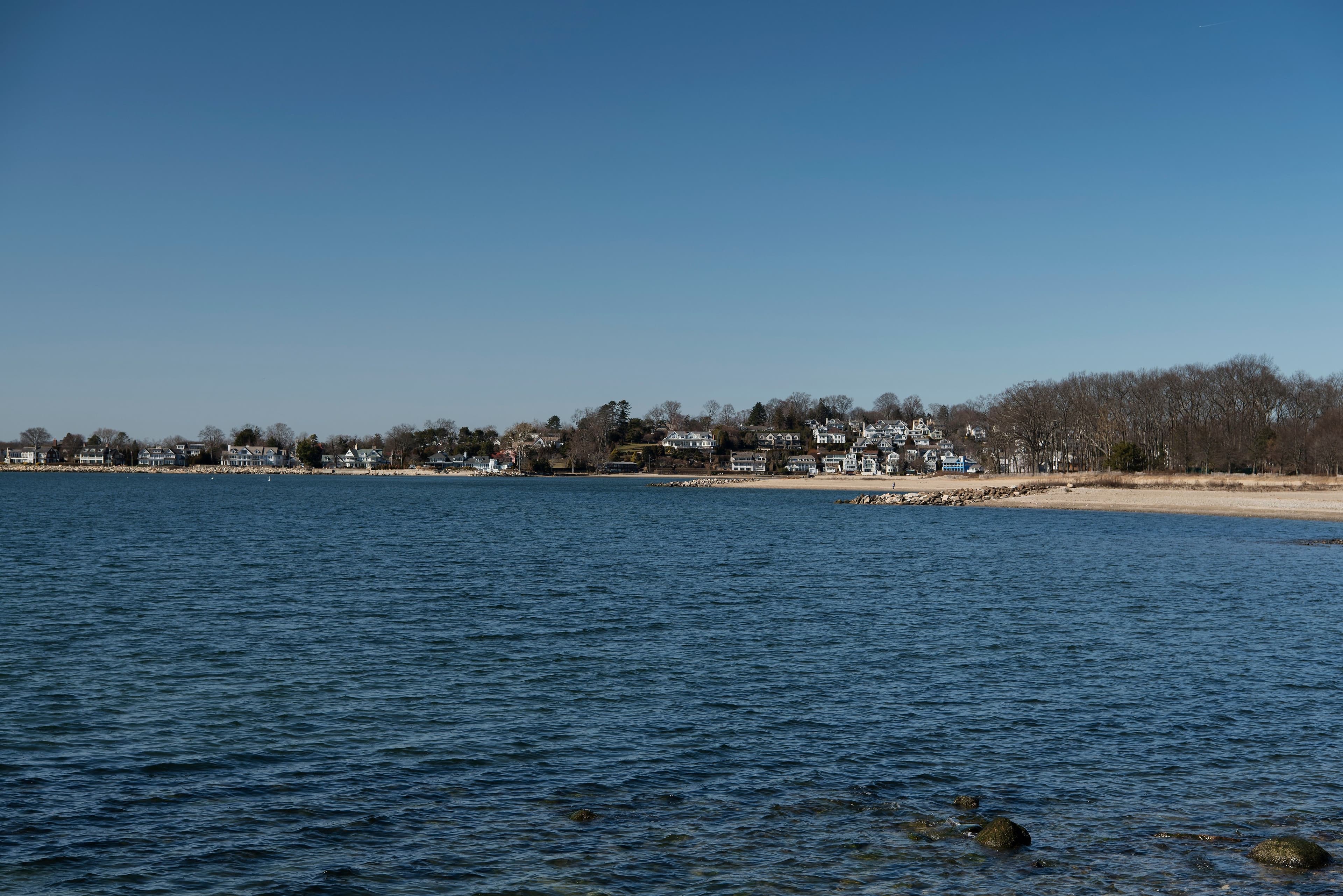
The beach neighborhoods south of the Post Road are the entry point most buyers discover first. Fairfield Beach Road and the streets branching off it (Reef Road, Old Post Road, the lanes leading to Penfield Beach) contain some of the most walkable residential blocks in the county. The beach is the anchor: Penfield Beach and Jennings Beach provide public waterfront access, and the small commercial cluster at Fairfield Beach includes a deli, a pizza place, and a seasonal ice cream shop that draws families on summer evenings.
Housing near the beaches ranges from $700,000 for a compact cape or cottage to $2 million for a renovated colonial with water views. Lot sizes are smaller here (many under a quarter acre), and the homes sit close together in a way that creates genuine neighborhood density. Buyers coming from Brooklyn or Hoboken recognize the pattern immediately. It is suburban, but the density and walkability create a social infrastructure that more spread-out sections of town lack.
The Post Road (Route 1) runs through the center of Fairfield and serves as the commercial spine. It is not a quaint village street; it is a busy state road with strip malls, grocery stores, restaurants, and professional offices. That is worth acknowledging honestly. Fairfield's charm is in its neighborhoods and its beaches, not in its roadside commercial corridor.
Southport: The Village Within the Town
Southport occupies the eastern edge of Fairfield and operates as a self-contained village. The Southport Harbor, Pequot Avenue, and the cluster of antique homes around the Southport Village green create one of the most photographed settings in Fairfield County. The harbor is a working anchorage with a yacht club and seasonal moorings, and the streets closest to the water have a preserved, 18th-century quality that is distinctly New England.
The Pequot Library, housed in a Romanesque stone building on Pequot Avenue, anchors the village's cultural life and hosts an annual book sale that draws thousands. The Southport train station sits within walking distance of the village center, which makes this section particularly attractive to commuters who value being able to walk to the platform.
Housing in Southport is among the most expensive in Fairfield. Antique colonials on Pequot Avenue and Harbor Road sell in the $2 million to $5 million range. Streets a few blocks from the water offer more moderately priced options ($1.2 million to $2.5 million) but inventory is limited. Southport homeowners tend to stay, and the neighborhood does not experience the same turnover as other sections of town.
Greenfield Hill: Acreage, Orchards, and the Dogwood Festival
North of the Merritt Parkway, Fairfield transforms. Greenfield Hill is the town's rural heart, defined by stone walls, winding lanes, two-to-five-acre lots, and a landscape that shifts from suburban to agricultural. The Greenfield Hill Congregational Church, a white-steepled landmark visible from the surrounding roads, hosts the annual Dogwood Festival each May, a tradition that has been running for more than seventy years.
The housing stock in Greenfield Hill is a mix of antique farmhouses, mid-century colonials, and newer construction on subdivided parcels. Prices run from $1 million to $3.5 million depending on acreage, condition, and views. The lots here are legitimately large; many properties include outbuildings, stone walls, and enough cleared land to support a garden or a small orchard.
Greenfield Hill draws a specific buyer: someone who wants the Fairfield school system and beach access but does not want to live in a dense neighborhood. The trade-off is a longer drive to the train station (10 to 15 minutes to the Fairfield Metro station) and a more car-dependent daily routine. Buyers commuting two to three days a week absorb that trade-off easily.
Schools: The Dual-High-School Dynamic
Fairfield operates two public high schools: Fairfield Ludlowe (serving the eastern half of town, including Southport) and Fairfield Warde (serving the western half). Both are strong, and both rank well in state assessments. The dual-school structure means that the school assignment is geographically determined, and buyers should confirm which school zone applies to any property they are considering.
The elementary and middle schools that feed each high school maintain a consistent standard. The Fairfield school system does not carry the same elite reputation as Darien or New Canaan, but it performs well and serves a larger, more diverse student population. Families who value a broad extracurricular offering and competitive athletics alongside strong academics will find the Fairfield system to be well-rounded.
Market Position and Value
Fairfield sits in a pricing sweet spot within the county. It is less expensive than Greenwich, Darien, or Westport for comparable square footage and lot size, but it delivers the same core package: strong schools, beach access, and a Metro-North commute under 70 minutes (express from the Fairfield Metro station to Grand Central runs approximately 62 minutes).
Entry-level single-family homes start around $600,000 for a dated cape or ranch in the western sections. The $800,000 to $1.5 million range covers the bulk of family home transactions: three-to-four-bedroom colonials on quarter-acre lots with updated kitchens and proximity to one of the beaches. Above $2 million, the market shifts to Southport waterfront, Greenfield Hill acreage, or fully renovated homes in the most desirable beach-adjacent neighborhoods.
Fairfield consistently attracts buyers who started their search in Westport or Darien and adjusted their budget after seeing what the market offered at their price point. A buyer priced out of a Darien colonial at $2 million can often find a comparable home in Fairfield for $1.3 million to $1.6 million with a similar school-quality profile and an equivalent commute.
If you are considering Fairfield, the starting point is deciding which section of town matches your priorities: beach walkability, Southport's village character, or Greenfield Hill's acreage. I can map out the options at your price point across all three. Reach out anytime. Matt Caiola, Higgins Group Private Brokerage.